Batik workshop in Jogja: prices, times, and how to book
Most people who write to us are already in Jogja. They have a free afternoon, they have seen batik in a shop on Malioboro, and they want to know four things: how much, how long, where, and can we come today.
So here are the answers, in that order, with nothing left vague.
How much does a batik workshop in Jogja cost?
Three options, one price each, everything included:
- One Color — Rp 300.000, about 2 hours in the studio
- Multiple Colors — Rp 400.000, about 3 hours, morning session only
- Batik on T-Shirt — Rp 500.000, about 4–5 hours depending on the design, starting in the morning session
That price is per person, and it is the whole price. It covers the cloth, the wax, the canting, the dyes, an artisan sitting with you the entire time, light refreshments, and the finished piece you take home. There is no materials surcharge, no studio fee and no tip expected.
If you are choosing between them: One Color is the real thing in the shortest time — you draw, you wax, you dye once, you go. Multiple Colors gives you a second and third dye bath, which is where batik starts to look like the batik you saw in the shop. Each colour has to dry in the sun before the next one goes on, which is why it runs in the morning only. Batik on T-Shirt is the same process done on a shirt in your size rather than a square of cotton, and it is the one families pick, because a child would rather wear it than frame it. A shirt takes far longer to wax and dry than a square of cloth, so plan on most of the day and arrive before noon — start at one o'clock and you will still be here in the evening. Decide on your design before you come, too; a photo or a sketch on your phone is plenty, and it saves the time a shirt does not have.
How long does it take, really?
Two hours means two hours of you working, not two hours of watching.
The sequence is fixed by physics, not by a timetable: you cannot dye before the wax has set, and you cannot boil the wax out before the dye has taken. Roughly half an hour on choosing and sketching your pattern, an hour or more with the canting and hot wax, twenty to forty minutes of dyeing, then a quarter of an hour of boiling the wax out while you have a drink. We have written the whole sequence out stage by stage, if you would like to know exactly what you are walking into.
Sessions start at 09:00 and 13:00, every day, and the studio is open 09:00 to 16:00 — the afternoon session is the last one of the day.
Can I book for today?
Usually, yes — and most people do.
Most of our guests book for the same day or the next one. That is who this workshop is for: someone already in the city, deciding over breakfast. Message us on WhatsApp with how many people and which session, and you will have an answer in minutes rather than hours.
Two honest warnings about same-day booking. Our afternoon session fills before the morning one — if you only have one free day, ask for 09:00. And Friday is our busiest day of the week by a wide margin, so a Friday afternoon is the one slot we do sometimes have to turn down.
If you are planning further ahead, you can book weeks out just as easily. Pick a date on the booking form and you will get a confirmation with everything you need.
Where is the studio?
In Jogja itself, a few minutes from the Kraton — not out in a village an hour away, which matters more than it sounds. A batik workshop that eats half a day in transport is a batik workshop you do instead of Borobudur. This one you can do as well as Borobudur.
Most guests fit us into a day that already has something else in it: Prambanan in the morning and batik at one o'clock, or the Kraton and Taman Sari on foot and then straight here. Tell us your plan on WhatsApp and we will tell you which session actually fits. If you need transport arranged, ask — it is easier for us to sort than for you.
Do I need any experience? What about children?
None at all. Nobody arrives knowing how to hold a canting, and the first ten minutes are spent learning it on a scrap of cloth rather than on your piece.
Children from about seven are very welcome, with a parent working alongside them. The tool is hot — it carries melted wax at around 70 °C — so it is a supervised activity rather than a drop-off one. Below seven, children are still welcome in the studio, and most of them end up drawing on paper next to a parent who is drawing on cloth. That works better than anyone expects.
What do I take home?
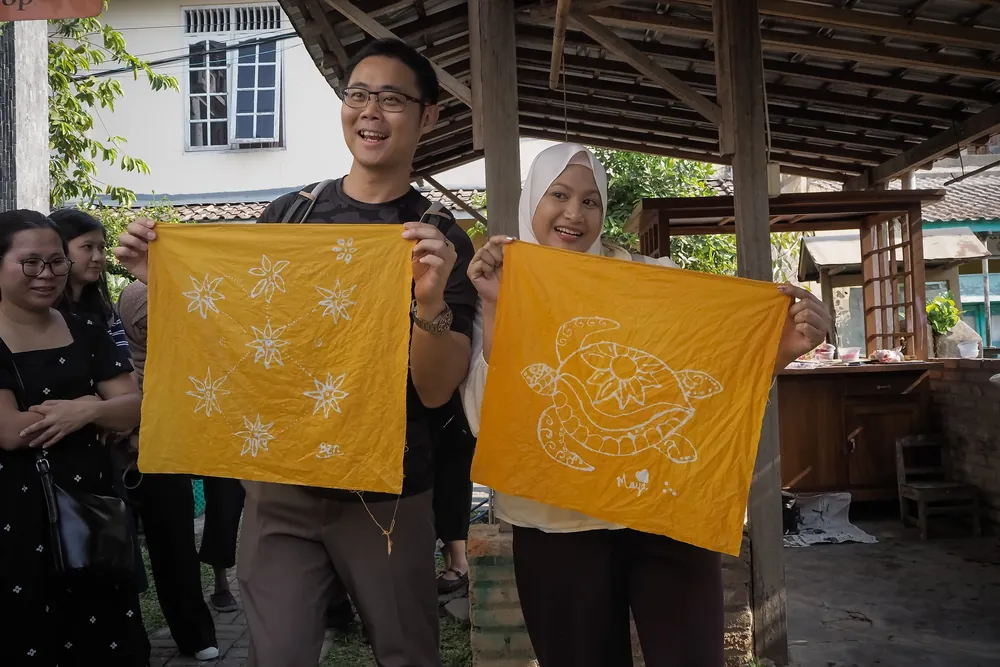
Your own finished batik, dry, folded, and yours.
Not a piece someone finished for you while you watched. The wobble in your line stays in the cloth, which is the whole point — hand-drawn batik is identifiable precisely by those imperfections, and in fifty years it will still be obvious that a person made it and not a printing roller.
A word on the first wash, because it is where good pieces get ruined: natural dye and ordinary detergent do not get along. We have written the washing instructions down separately — it is worth two minutes before you put it in a hotel laundry bag.
How do I pay?
QRIS, bank transfer to our BNI account, or cash at the studio when you arrive. Cash on arrival is what most of our guests choose, and it is completely normal here — you are not asked to pay anything up front to hold a slot.
Free cancellation up to 24 hours before your session, and you can move your booking to another day at no cost, as many times as you need. Plans change on a trip. We would rather you came on a day that suits you.
Is it worth it?
We are obviously not neutral, so here is the honest version.
If you want a souvenir, the shops on Malioboro are cheaper and faster. If you want to understand why a real batik costs what it costs, three hours with a canting will teach you more than any museum label — and you will never again mistake a printed batik-patterned shirt for batik. Batik is a method, not a pattern, and the method is the sort of thing you only really learn with wax on your fingers.
That is also why our guests are mostly people who booked on a whim the day before and then stayed the full three hours when they had planned on two.
Ready?
Book a batik workshop in Jogja — pick a date, a session and how many of you there are. Or message us on WhatsApp if you would rather ask a question first. Both reach the same studio, and usually the same day.