What batik actually is
Most people meet batik as a look: brown and cream, dense geometry, the shirt your Indonesian colleague wears on Friday. That is the most common misunderstanding we hear in the studio, and it is worth clearing up before you ever pick up a tool.
Batik is not a pattern. Batik is a resist-dyeing method, and the pattern is only what the method leaves behind.
The whole idea in one sentence
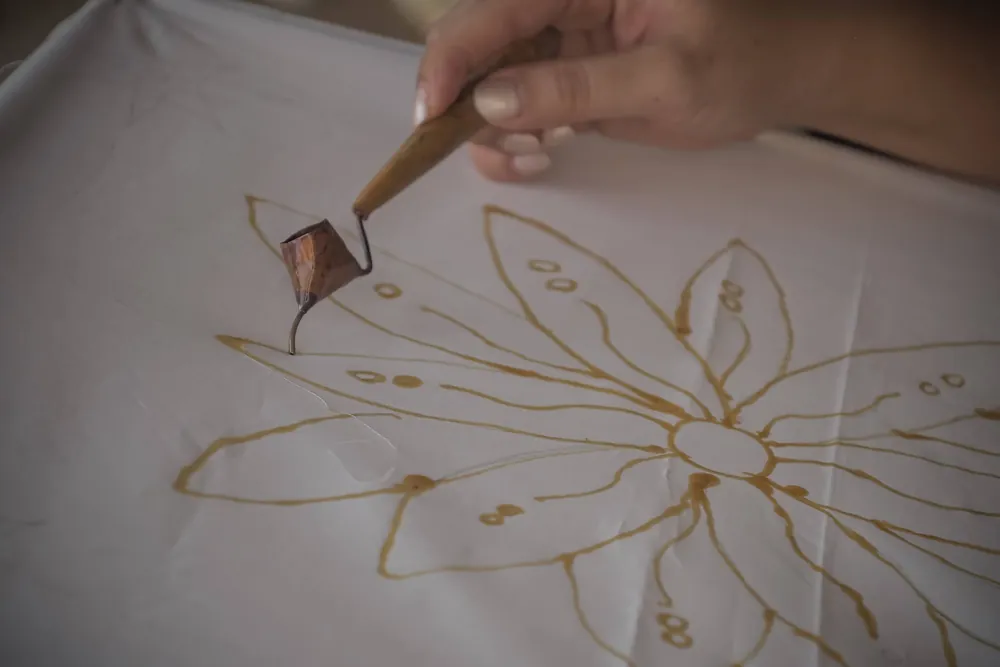
You draw on cloth with hot wax. The waxed parts cannot absorb dye. You dip the cloth. You boil the wax off. Wherever the wax was, the cloth stayed its old colour.
That is it. Everything else — the tools, the motifs, the four-hundred-year-old court rules about who may wear what — is built on that single physical fact.
Three things sold as batik
Only two of these are batik at all.
Batik tulis is drawn by hand with a canting, one line at a time. A simple piece takes days. A fine one takes months. Every line carries the hand that drew it, which is why no two are identical even when the motif is.
Batik cap is stamped with a copper block dipped in wax. It is still real batik — wax, resist, dye, boil — but the block repeats exactly. A skilled capper covers a two-metre cloth in an afternoon.
Batik print is not batik. It is a batik pattern printed onto fabric with dye or pigment. No wax touches it. It is often perfectly nice cloth, and it is what most souvenir shirts are, but calling it batik is like calling a photograph of a painting a painting.
Why the method matters to the price
A printed shirt costs what printing costs. A tulis cloth costs what a person's weeks cost. When you see the same motif at wildly different prices, the motif is not what you are paying for — the method is.
What you will do here
In a workshop you make batik tulis, on a small scale. Your lines will be thicker than an artisan's and your motif will be simpler, but the process is not a simplified version of anything. It is the same wax, the same canting, the same dye baths, the same boiling pot.
That is the point. You are not making a souvenir of batik. You are making batik.
If you want the practical side — what a batik workshop in Jogja costs, how long it takes and whether you can come this afternoon — we have written that out separately.