What happens in a batik workshop, step by step
People book a workshop without quite knowing what the three hours contain. Here is the sequence, honestly, including the waiting.
1. Choosing and sketching — about 30 minutes
You pick a motif. Most guests draw something of their own; some copy a classical pattern from the studio's samples. You sketch it on the cloth in pencil, lightly, and the pencil will disappear in the dye.
This takes longer than anyone expects, and it is worth taking. Every later stage follows this line.
2. Waxing — about 60 to 90 minutes
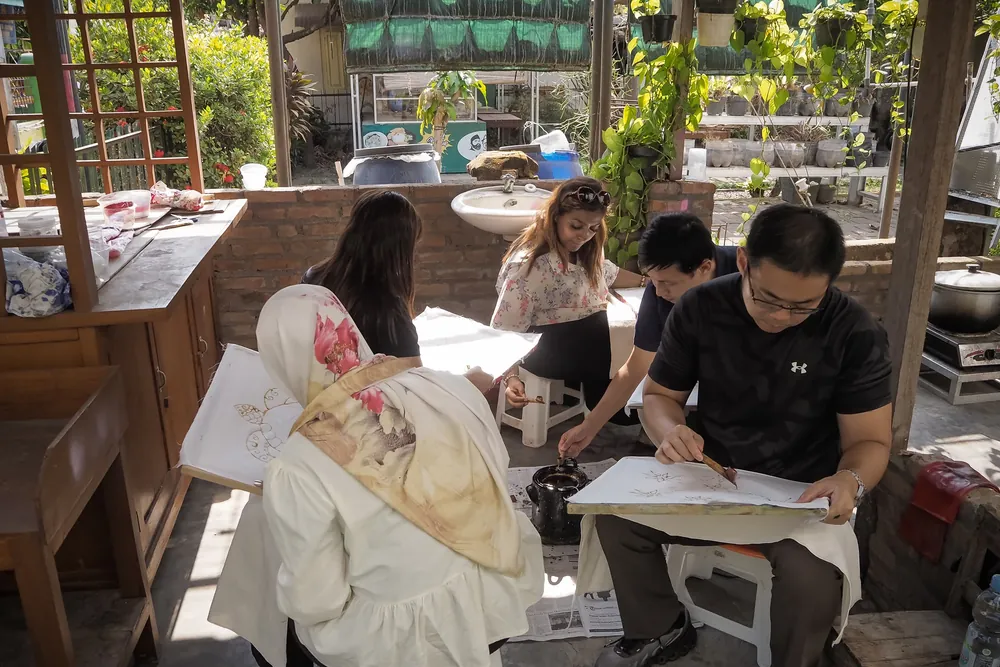
The cloth goes on a frame. You fill the canting from the pot, hold it nearly flat, and trace your pencil line in wax.
This is the part that is genuinely difficult and genuinely absorbing. Most guests go very quiet here. The wax will not be erased, and after the first few minutes almost everyone stops minding.
If you are making a multi-colour piece, waxing happens more than once — you wax, dye the lightest colour, wax again over what you want to keep that colour, and so on.
3. Dyeing — 20 to 40 minutes
Outside, at the dye trays. Gloves on. The cloth goes in, comes out, and drips. For indigo you watch it turn from green to blue in the air.
Then it hangs and waits, which is the one stage you cannot hurry.
4. Boiling out — about 15 minutes
The piece goes into a pot of boiling water and the wax lifts out and floats. This is nglorod, and it is the moment the design appears — until now your cloth has been a sheet of colour with pale wax lines on it.
Almost everyone photographs this.
5. Rinsing and drying — 20 to 30 minutes
Rinsed, hung, and while it dries there is tea and the artisans will show you what a full tulis piece looks like — the thing your three hours is a small piece of.
What you take home
A finished cloth or T-shirt, still slightly damp. Bring a plastic bag. This is the single thing guests most often wish they had known.
What you do not get
You do not get a fine batik in three hours. A real tulis is weeks of one person's life. What you get is the whole process at small scale, done properly, with your own hand in every stage — and a much better idea of what you are looking at in every shop afterwards.
Practical questions
Prices, session times, whether you can come the same day and how to get here are all in one place: our guide to booking a batik workshop in Jogja.