Malam: the wax that makes batik possible
The word batik is usually traced to amba (to write) and titik (dot). Neither of those is the hard part. The hard part is the wax.
What malam actually is
Not one substance — a blend, and studios guard their proportions:
- Beeswax (malam tawon) — flexible, sticks well, forgiving
- Paraffin — cheap, hard, and the source of deliberate crackle
- Gondorukem, pine resin — makes it adhere and penetrate
- Damar — hardness and shine
- Kendal / lemak — fat, to keep the mixture from becoming brittle
Different jobs get different blends. Wax for fine outlines needs to flow and hold a 0.5 mm line. Wax for blocking out large areas needs to be cheap and to sit there. Wax for deliberate crackle needs to be brittle.
The four things it must do at once
- Melt low enough. Around 60–70 °C. Hotter and it soaks the cotton and spreads past your line.
- Set fast. The line has to stop being liquid almost as soon as it lands, or the drawing runs.
- Resist completely. Any gap and the dye is under your line — visible forever.
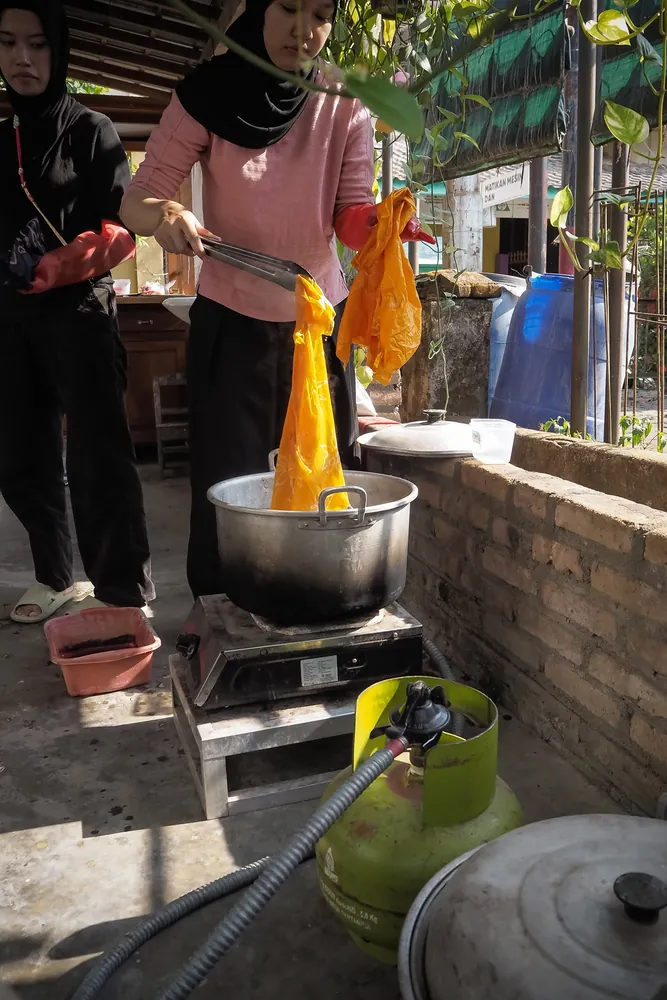
- Come out completely. This is the one people forget. Wax that does not fully release in boiling water leaves a stiff, shiny patch nothing will remove.
Any wax can do two of those. The blend exists to do all four.
Crackle is a decision
The fine veins of colour across an old batik — remekan — are not damage. Brittle paraffin-heavy wax is cracked on purpose before the last dye bath, and the dye runs into the fractures.
How much crackle, and where, is a choice the maker makes. On classical court batik it is usually avoided entirely; on coastal and contemporary work it is often the whole point.
Wax is recycled, and that is why the pot is dark
The wax boiled out in nglorod floats and is skimmed, cooled and used again. It gets darker every time it goes round.
The nearly black wax in a busy studio's pot is not dirt. It is years of the same wax, having been through hundreds of cloths — which is a fairly good description of the craft as a whole.