Reading batik motifs: kawung, parang, truntum
In the Yogyakarta and Surakarta courts, a batik motif told you who someone was. Some patterns were larangan — forbidden to anyone outside the royal household. Wearing the wrong cloth was not a fashion error.
Here are three you will see constantly, and what they carry.
Kawung
Four ellipses arranged around a centre point, repeating across the whole cloth. The name comes from the kolang-kaling, the translucent fruit of the sugar palm, which is exactly that shape in cross-section.
Kawung is one of the oldest motifs on Java — it appears carved on temple walls centuries before it appears on cloth. In the courts it was restricted to the ruler and close family. Its usual reading is self-control: the four points around one centre, appetites ordered around a still middle.
It is also the motif a beginner should not choose. Perfect ellipses, endlessly repeated, are unforgiving.
Parang
Diagonal bands running corner to corner, each filled with a repeated S-curve. Parang means chopping knife, and one reading of the shape is a blade; another is waves breaking on the south coast.
Parang rusak — "broken blade" — was the most restricted pattern of all, reserved for the ruler. Lesser versions were allotted downward through the ranks by the width of the band.
The diagonal is the important part. Parang is never drawn straight, and a batik with vertical stripes of S-curves is not parang; it is someone who did not know.
Truntum
Small stars or flower heads scattered evenly on a dark ground. The story attached to it is unusually specific: it is credited to a queen of Surakarta who, neglected by her husband, made batik at night and drew what she could see — the stars. He noticed the work, then noticed her again.
So truntum reads as love that returns. It is traditionally worn by the parents of a bride and groom rather than the couple — the generation whose love has already had to be rediscovered once or twice.
What this means for your own piece
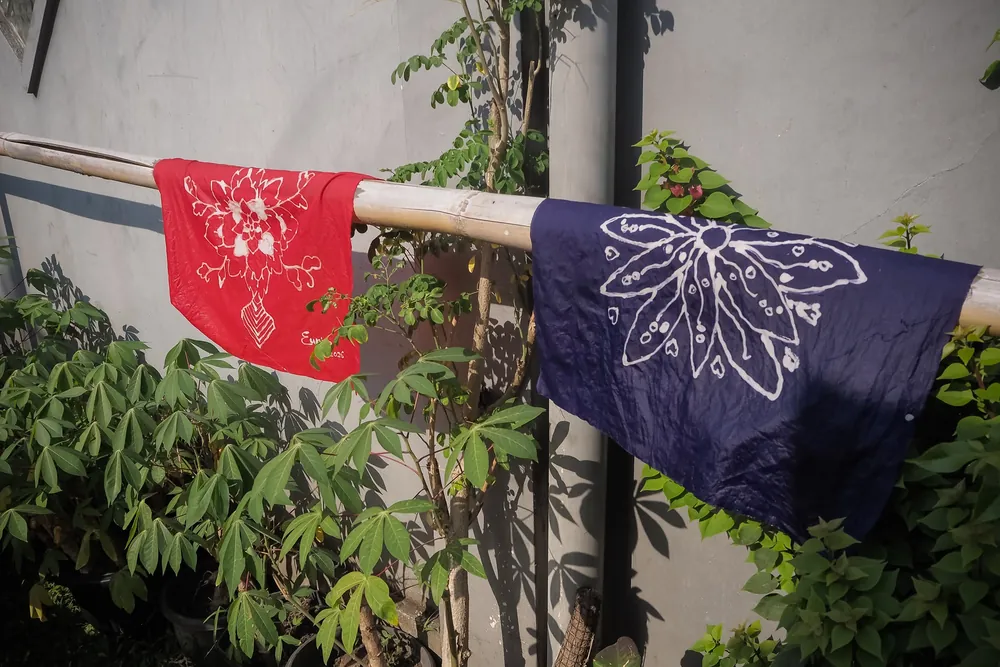
Nothing, and that is allowed. Guests draw turtles, names, hibiscus, their dog. Classical motifs earned their meanings over centuries inside a court that no longer governs what anyone wears.
But it is worth knowing that the cloth you buy in Malioboro may be saying something, and that someone in this city can still read it.