Natural dyes: indigo, soga, and what they are made from
For most of its history Javanese batik used a very small palette: a deep blue, a warm brown, and the white of the cloth itself. That was not a lack of imagination. It was what the plants around the studios could reliably give.
Indigo — the blue
Indigo comes from the leaves of Indigofera tinctoria, a shrub that grows readily in Java. The leaves are fermented in water, and the liquid is beaten with air until the pigment separates.
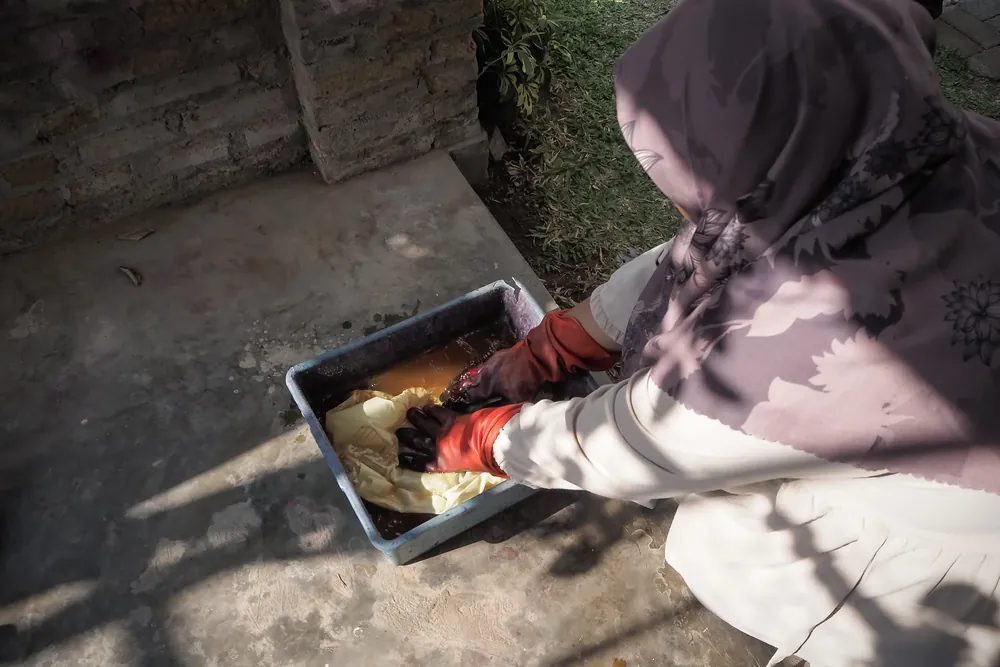
The strange part is that an indigo bath is not blue. It is a greenish yellow. The cloth comes out of it greenish yellow too — and turns blue in front of you, over about a minute, as the air oxidises the pigment. Guests who see this for the first time almost always make the same noise.
Blue depth is built by repetition, not by strength. Five short dips give a better colour than one long one.
Soga — the brown
Soga is not a single dye but a recipe, and the recipe is bark: tingi for red-brown, tegeran for yellow, jambal for depth. Each is boiled separately and then blended, and the proportions are what one studio does differently from the next.
The bark is cheap. What is expensive is time — a deep soga is seven dips with drying in the shade between each one, which means a piece of cloth occupies a frame for the better part of a week.
The others
Beyond those two: mango leaves and turmeric for yellow, secang wood for red, mahogany bark for a darker brown, and various combinations over-dyed on top of each other. Green is almost always yellow over indigo, not a green dye.
How natural dye behaves over time
It fades. That is worth saying plainly, because a shop that claims otherwise is selling something else.
But it fades evenly, because the colour sits in the fibre rather than on it. A natural-dyed cloth ten years old looks softened; a synthetic one of the same age often looks patchy. Many people prefer the older piece.
And synthetics, honestly
Most batik made today, including a lot of very good batik, uses synthetic dyes. They are faster, brighter, more repeatable, and available in colours no plant will give you. We use them too — the bright pieces guests take home from a half-day workshop are synthetic, because no natural dye reaches that depth in three hours.
Natural dye is not better. It is slower, quieter, and older, and it is worth knowing which one you are looking at.